

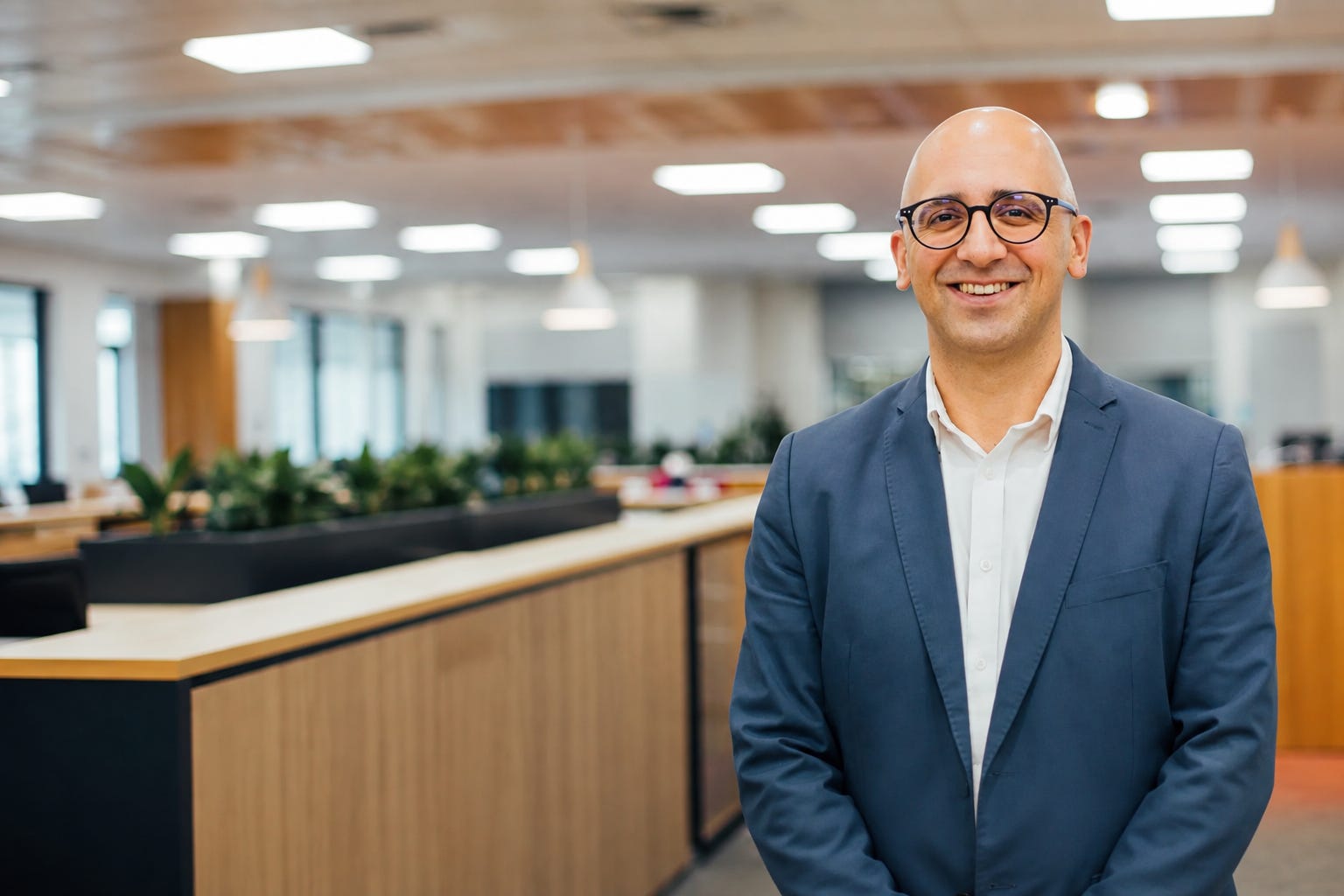
Husain is the first guest voice in the series, which is fitting, because he was one of the first voices I heard from this country in the first place. I was still in Wales, working out whether a move to Aotearoa was just an idea, or could really work.
After a cold LinkedIn message, Husain shared a couple of hours of his time, with no expectation of anything in return, that really gave me a soft landing when I eventually got here.
My post on Tuesday was exactly about that kind of contribution, and this post is written from inside a room with nearly 150 people coming together with the same instinct - collaborating for real change, and I’m proud to be a part of it.
- Daf
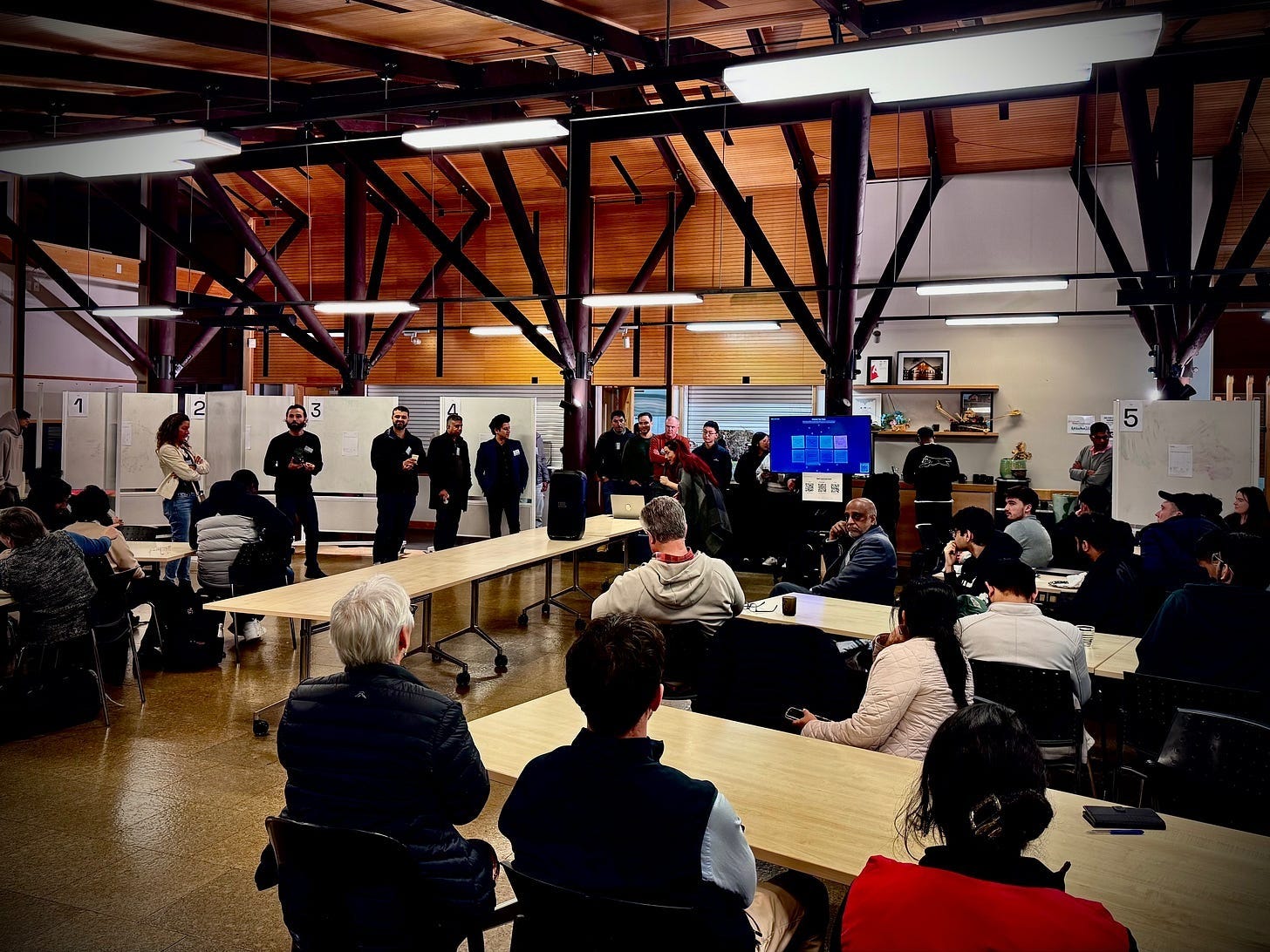
Most teams here didn’t know each other yesterday morning, and are now finishing each other’s sentences. Each team has a whiteboard, which was the starting point of the idea from last night, but they’ve already started crossing things out and tweaking their idea, which is the sign of a team working together well.
The early birds were waiting outside before the campus opened this morning. Seven o’clock, standing about, wanting to get back in.
Forty-eight hours. The clock started at five yesterday and it stops at five tomorrow.
Starting in the right spirit
We opened at 5pm yesterday on Te Noho Kotahitanga Marae, with a mihi whakatau, to bring everyone together properly, grounding them in the right purpose, values, and connection. Hackathons often value the idea and the tech, but we believe the journey and the people you’re on it with are more valuable.
People walked in as a few hundred separate arrivals and came out as one group, and the kōrero that follows is different from the one you get out of a lanyard and a coffee queue. It was the most efficient hour of the whole day, and it was the hour with no phones or laptops in it. Sharing of kai (food) followed to cement the connection.
Then we moved into the formal proceedings of the hack mode and the pitching started. Within a couple of hours there were ten teams. Not fully articulated ideas, but teams formed, named, and already arguing productively about scope.
Daf asked me to write this while it was still going on rather than afterwards. I said yes because the room answers a question his last post asked, and answers it better than an abstract argument ever could.
What everybody in here brings
Nobody was paid to come.
There are students, engineers here who have day jobs, designers, and people who would not call themselves technical at all and are here anyway. Some took leave. Many will be very tired at work on Monday.
And there are high school students from Rosmini College, who deserve a particular mention, because they are not here to watch.
They are spread across several teams doing real work inside them, and two of their teachers gave up their nights and most of their weekend to come with them and make sure they landed in the fabric of the event rather than at the edge of it.
Then there are the mentors with years of experience, walking between tables and giving their time and expertise generously. Daf is one of them, which is roughly how this post came about. Nobody invoices for that. It is closer to koha than consultancy.
And underneath all of it, the thing that is hardest to see and does most of the work: a room of near-strangers who decided within about an hour to trust each other enough to build something together.
No contracts. No due diligence. Somebody said what they were good at, somebody else believed them, and a team existed. A real team, a real idea, built in an hour, in a borrowed building, between people who owed each other nothing.
Daf’s post on Tuesday called that social and human capital, and made the point that almost everybody already holds some and almost nobody ends up owning anything as a result.
I run a venture studio, so people think I am supposed to think in cap tables, but the cap table has no row for any of this. The most valuable input in this building today is the willingness of these people to give each other the benefit of the doubt, and build around shared purpose.
Why do we run this at all?
People assume a hackathon is deal flow for a studio, but that’s not the studio we set out to build at Seen. Purpose was always at the heart of what we set out to build.
I have been running rooms like this one for most of my working life. Nearly twenty years of it at Datacom, on the Growth and Innovation side, doing this mahi for people and organisations that had never been given the room, the time, or the permission.
You learn a few things doing that for two decades. The main one is that the quality of what comes out has almost nothing to do with the size of the organisation paying for it, and almost everything to do with whether the people in the room believe they are actually allowed to build.
We built Seen Ventures on a simple conviction: that imagination becomes ventures and people become builders. We truly believe that anyone can become a builder in the Age of AI.
The thing missing in Aotearoa has never been ambition. I have never once been in a room here short of ideas. What is rare is the number of people who have been given a real reason to believe they are allowed to build, and then handed the tools and the company to do it.
That is what forty-eight hours is for. It is the shortest honest distance between “I have an idea about that” and “I have made something that could work, and I know exactly how to scale it”. You get more learning in this timeframe than in weeks of work. It is amazing what an atmosphere of innovation and togetherness, a deadline, a team, and experienced mentors on your side can do.
We do not outsource innovation, we grow it with people, which means the studio is only ever as good as the number of builders in the country. A weekend like this is one of the few ways to move that number.
The “for good” part is the part nobody owns
Look at what these teams have chosen to point at.
Water. Waste, including what happens to the food that is grown and never sold. Climate, modelled and made legible. Accessibility, so that things work for the people they currently do not work for. Language. Schools trying to find money. Learning itself. Keeping people safe from the same tools everybody in this room is using.
And, from two teams that formed independently and had not spoken before Thursday night, loneliness. One of them approaching it through people who have just arrived in this country and do not yet belong anywhere in it. The other through people who have been here all along and are on their own.
Nobody coordinated that. The brief said environmental and social impact and left the rest wide open, and nearly every team in this building has walked, unprompted, towards something that belongs to all of us and to nobody in particular.
That is worth thinking about. Give a room of capable people a free weekend and no owner to serve, and they rarely build another way to sell advertising. They go straight for the commons. A river. A coastline. A language. Whether a person has anyone to talk to. A body of public knowledge everyone draws on and nobody maintains.
Which is exactly what the ledger has never known how to hold, and, as it happens, exactly where this series goes next week.
The question I cannot answer by tomorrow at five
At five o’clock on Saturday, one team walks out of here with a genuine shot at building a real company with us. We mean that offer, and we will honour it.
But considerably more value than one company will have been created in this building by then, and I have no honest mechanism for recognising most of it. The mentor who unlocked three teams and appears on none of them.
The person whose idea got absorbed into somebody else’s build on Friday afternoon, which is how good work usually travels. The 120+ people who go home on Saturday with a capability they did not have on Thursday, which is real, and theirs, and shows up on nothing.
I am not going to pretend our studio model has solved that. It has not.
What I will say is that once you have watched a room create that much value with no ownership attached to it, “who ends up holding a stake in what gets built” stops being an abstract question about economics and becomes a practical one about the people in front of you.
That is why Seen is in this series. Not because we agree with every part of the argument, but because the argument is asking the right question, and I would rather it were asked properly than politely.
If you are reading this today
The room is still going until five tomorrow. If you are in Auckland and you have been meaning to find out whether you can build something, come and learn more: seen-ventures.com/hack.
And if you are not, the offer a the same one it always is. Come and be seen. Build what’s next.
If you had a magic wand
Daf ends every one of these with the question he asks in every meeting: if you had a magic wand, what are the three things you’d need right now? It is a good question and I am not going to duck it just because I am a guest. Mine, standing in this room:
Capacity and capital to scale our model.
More leaders who think about alternative futures for work and employment.
Collaboration partners who can help us take our approach to the world.
Now you? What are your three? Send a message to me or the Seen Ventures team, and tell us what we can help with. If it is about building something, we probably can.
